


Field Report · Roseville, MN
A Roseville Flat Roof That Didn't Need Replacing — and the Damage That Didn't Come From Hail
By Joe Dvorak, Owner, Modern Exterior Systems · Field report, June 2026
A real inspection, written up honestly. The homeowner's name and exact address are withheld for their privacy.
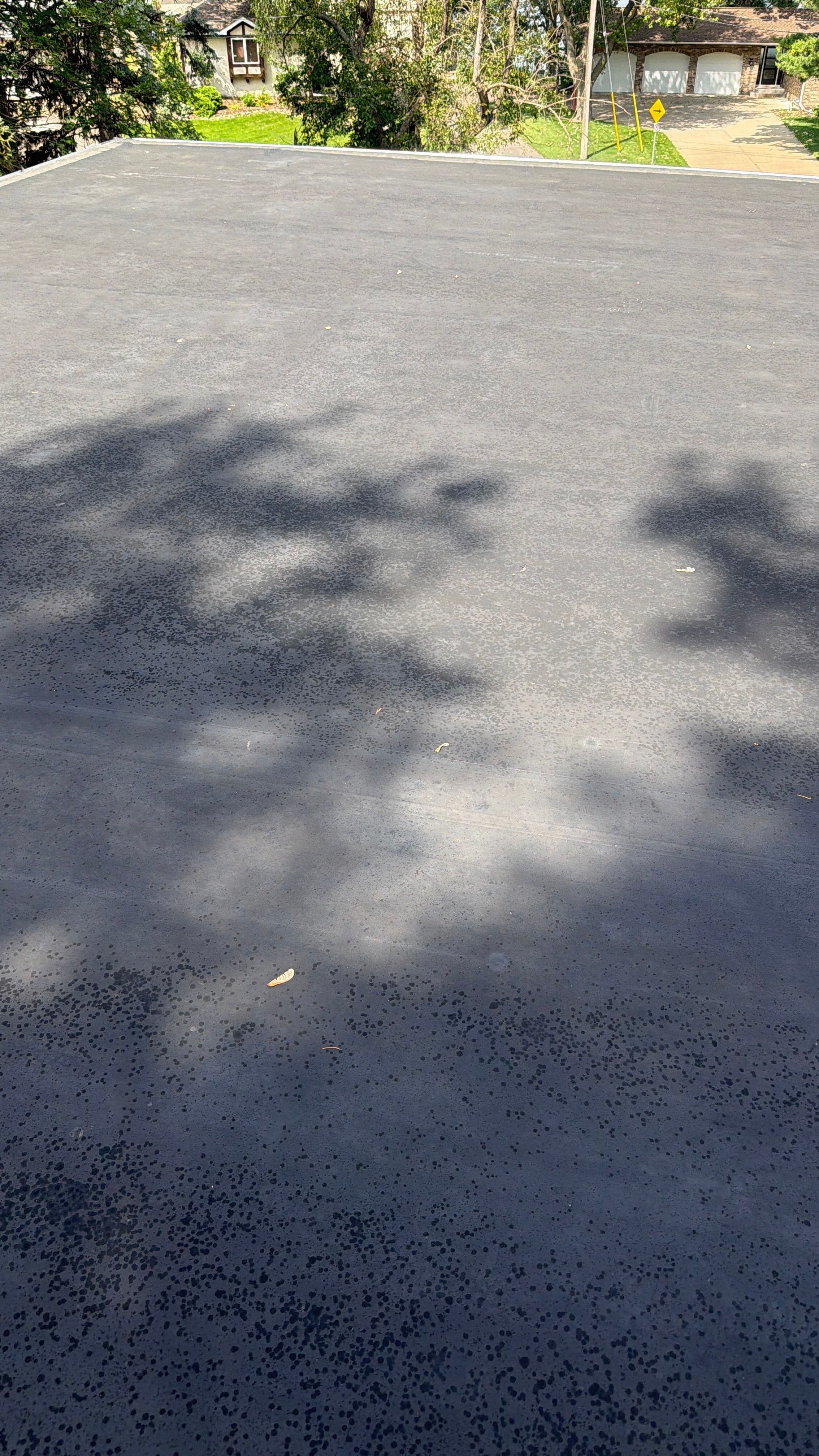
Most “case studies” are humble-brags. This one's a warning. A Roseville homeowner called us after a hailstorm because the contractors already circling didn't add up. By the time I got on the roof, two storm-chasing crews had already been up there right after the hail, and two more contractors had quoted a full flat-roof replacement. The roof didn't need one. Here's what I actually found.
The situation
Roseville took hail. Within days, the homeowner had door-knockers on the roof — the out-of-town crews that show up after every Minnesota storm. Two separate contractors who came out after that were both pushing the same thing: tear it off, replace the whole flat roof, put it through insurance. Big job, big number. One of them was still on the roof when I pulled up — and when I talked to him, it came out that he was a flat-roof subcontractor sent by a residential roofing company. He'd spent the better part of 30 minutes working the homeowner over about how bad the roof was, aiming squarely at a full-replacement quote.
Something didn't sit right with the homeowner, so they called us for an independent look. Smart move.
What I found on the roof
This is an EPDM (rubber-membrane) flat roof. Here's the honest, point-by-point assessment:
- The hail impact on the membrane was minor. Flat-roof membranes take hail differently than shingles — what matters is bruising, punctures, and seam separation, not granule loss. Across the open field, the membrane was sound. No widespread damage that would justify a tear-off.
- A couple of seams had opened up and needed attention — the kind of small, targeted repair that's normal maintenance on an EPDM roof, not a reason to replace it.
- The real problem was around the chimney — and this is the part worth paying attention to. The damage there did not match the hail pattern anywhere else on the roof. It was localized, it was recent, and it showed up after the door-knockers had been on the roof.
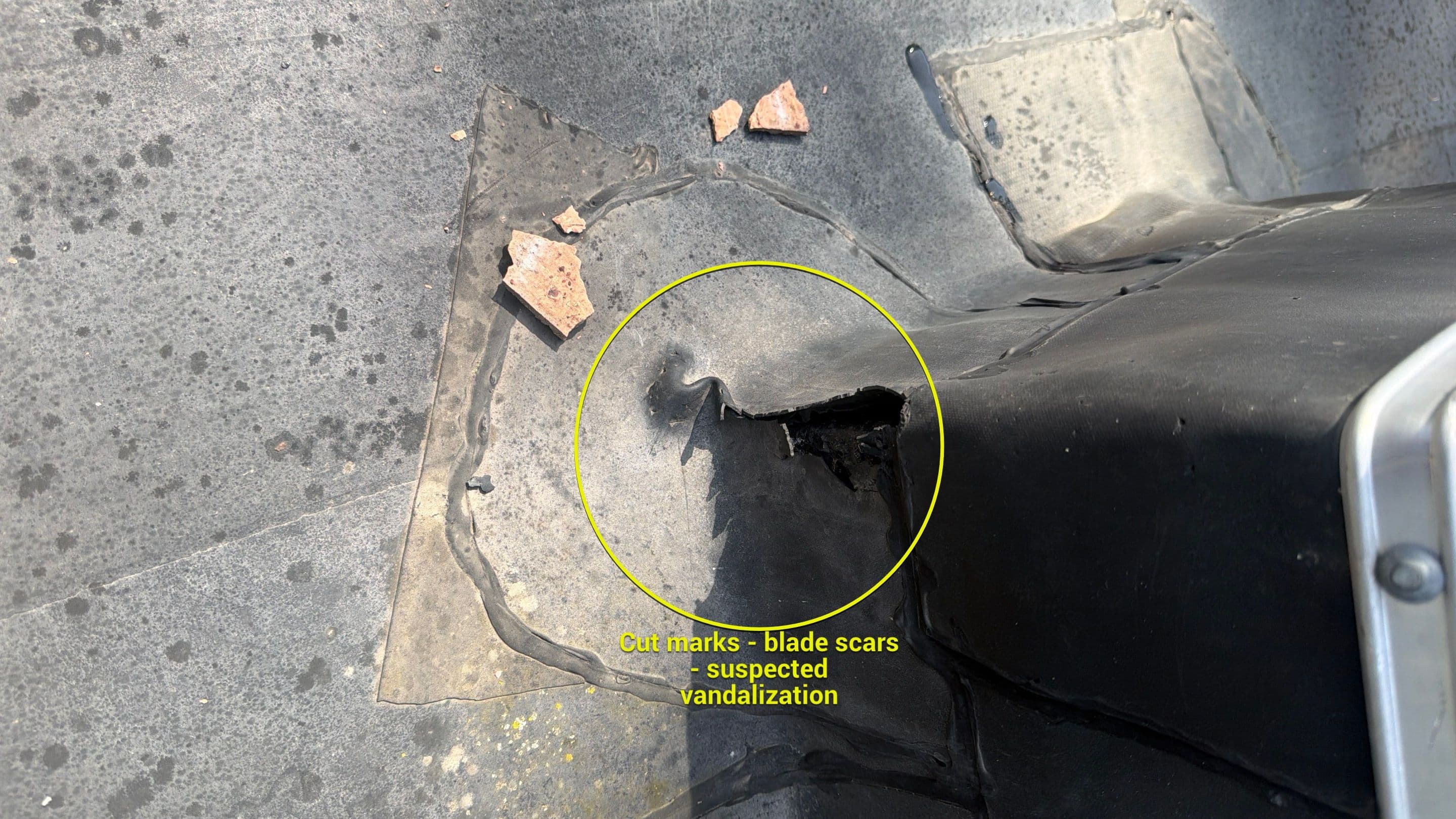
Clean, blade-like cut marks in the membrane at the chimney curb. Hail doesn't cut in straight lines.
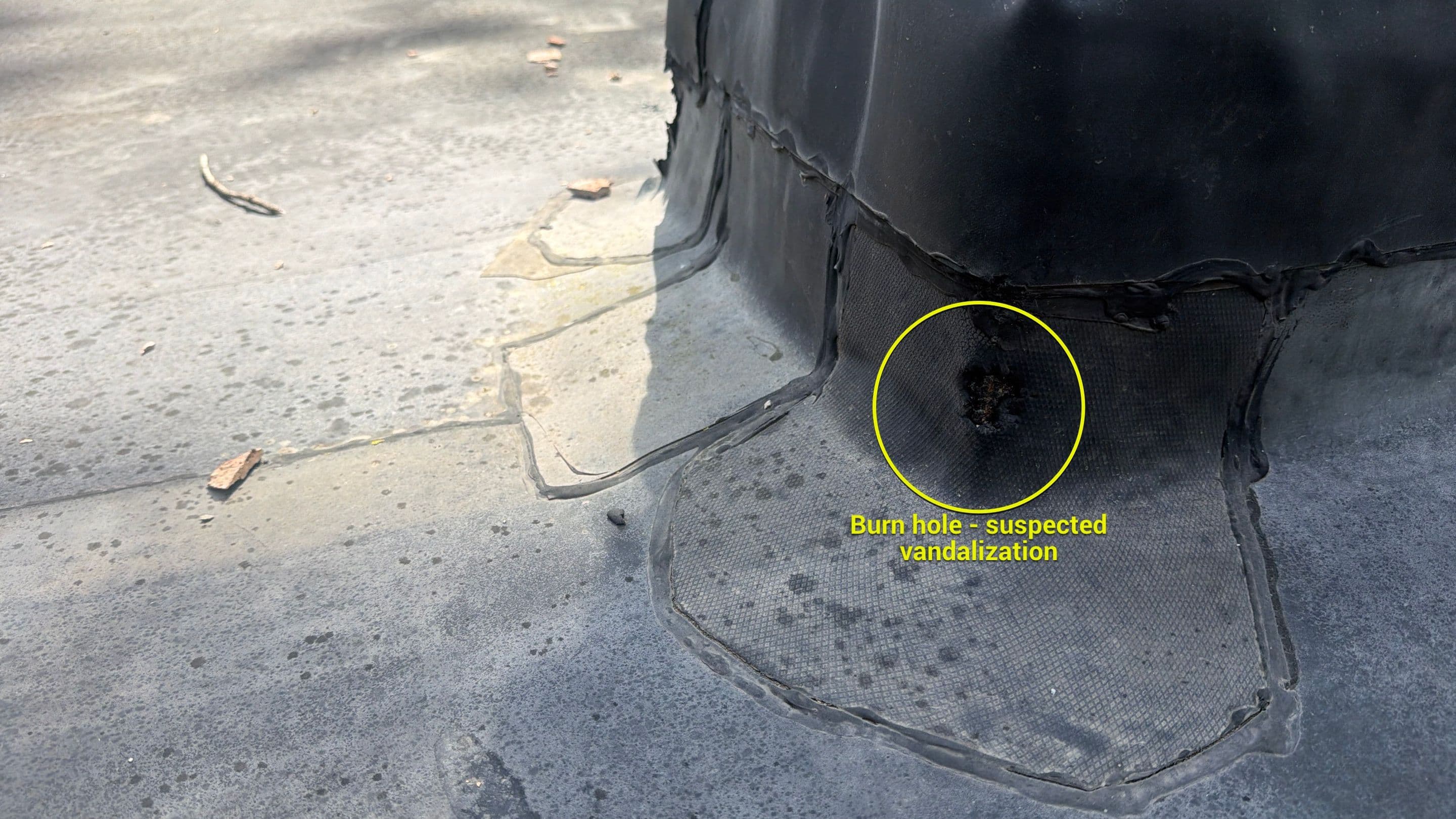
A burn hole melted clean through the membrane. There is no weather event that does this to a roof.
I'm not going to tell you who did it, because I can't prove it. I can tell you what the physical evidence shows: straight cut marks consistent with a blade, and a burn hole through the membrane. Neither of those comes from a storm. Both are exactly the kind of “damage” that conveniently turns a repairable roof into a replacement claim.
The honest verdict: repair, not replace
The roof needed a couple of small seam repairs and a repair of the damaged membrane and flashing around the chimney. That's it. Not a tear-off. Not a full replacement. Not the five-figure insurance job two other contractors were steering toward. We documented everything with photos, walked the homeowner through it, and scoped the actual repair. The difference between our answer and the replacement quotes wasn't a judgment call — it was the difference between fixing what's broken and selling a roof that doesn't need replacing.
The flat-roof blind spot in residential roofing
Here's the part most homeowners never hear, and it's the real lesson of this job.
A lot of residential roofing companies will tell you they handle flat roofs. The reality is that flat roofing is a different trade — different materials (EPDM, TPO, modified bitumen), different failure modes, different repairs — and a lot of shingle-focused companies don't actually know it well. Neither do their sales teams. So when a flat roof comes up, they send out a subcontractor and hope he can gather the right information and make a sound recommendation.
Sometimes that works fine. Often it doesn't — because the sub is the one looking for a big job, and the company selling it can't tell whether his recommendation is even right. That's how a roof that needs two seam repairs and a chimney fix becomes a five-figure tear-off quote, backed by 30 minutes of “you really need to worry about this.”
We don't sub out flat work. We self-perform EPDM, TPO, and modified bitumen — ballasted and adhered, on homes and on commercial buildings up to four stories. When I tell a homeowner their flat roof needs a repair and not a replacement, that's coming from the person who'd actually do the work — not a salesperson relaying a subcontractor's pitch. More on our flat roof work.
What every flat-roof owner should take from this
- A storm does not automatically mean a new roof — especially on flat roofs, where hail damage is often minor and localized. Get someone to actually assess the membrane and seams before you believe a tear-off quote.
- Be very careful who you let on your roof after a storm. Damage that “appears” after a door-knocker's visit is a known problem in this industry. Don't sign an inspection agreement that lets a stranger up there unsupervised.
- Get an independent opinion before you file or sign. Two contractors quoting a full replacement doesn't make it true. A second, honest set of eyes can be the difference between a few hundred dollars in repairs and a needless five-figure project.
- Ask whether your roofer actually does flat roofs — or quietly subs them out. Flat roofing is a separate trade from shingles. Ask who's doing the work, and whether they self-perform.
- Nobody can waive your deductible, and an inflated scope helps the contractor, not you. In Minnesota, deductible games are illegal — and so is letting someone talk you into work you don't need.
Flat-roof storm questions, answered
Does hail damage a flat roof?
Sometimes, but far less often than it damages shingles. On an EPDM or TPO membrane, hail rarely harms the open field — what matters is bruising, punctures, and open seams, not granule loss. Most hail “damage” on a flat roof is minor and repairable, not a reason to tear off the whole roof.
Should I replace my flat roof after a storm?
Usually not. A storm doesn't automatically mean a new roof, especially on flat roofs where hail damage is often minor and localized. Get an independent look at the membrane and seams before you believe a tear-off quote — a couple of seam repairs and a chimney fix is common; a five-figure replacement is not.
Does Modern Exterior Systems sub out flat-roof work?
No. We self-perform EPDM, TPO, and modified bitumen — ballasted and adhered, on homes and commercial buildings up to four stories. Many shingle-focused companies send a subcontractor for flat roofs; when we tell you repair vs. replace, it's coming from the crew that would actually do the work.
Got a flat roof and a stack of replacement quotes after a storm? Get a real second opinion first. We'll get on the roof, document what's actually there, and tell you straight — repair or replace — even when the honest answer is the smaller job.
Call Modern Exterior Systems at 952-206-6339 for a free, independent flat-roof inspection · Flat roof repair & replacement