

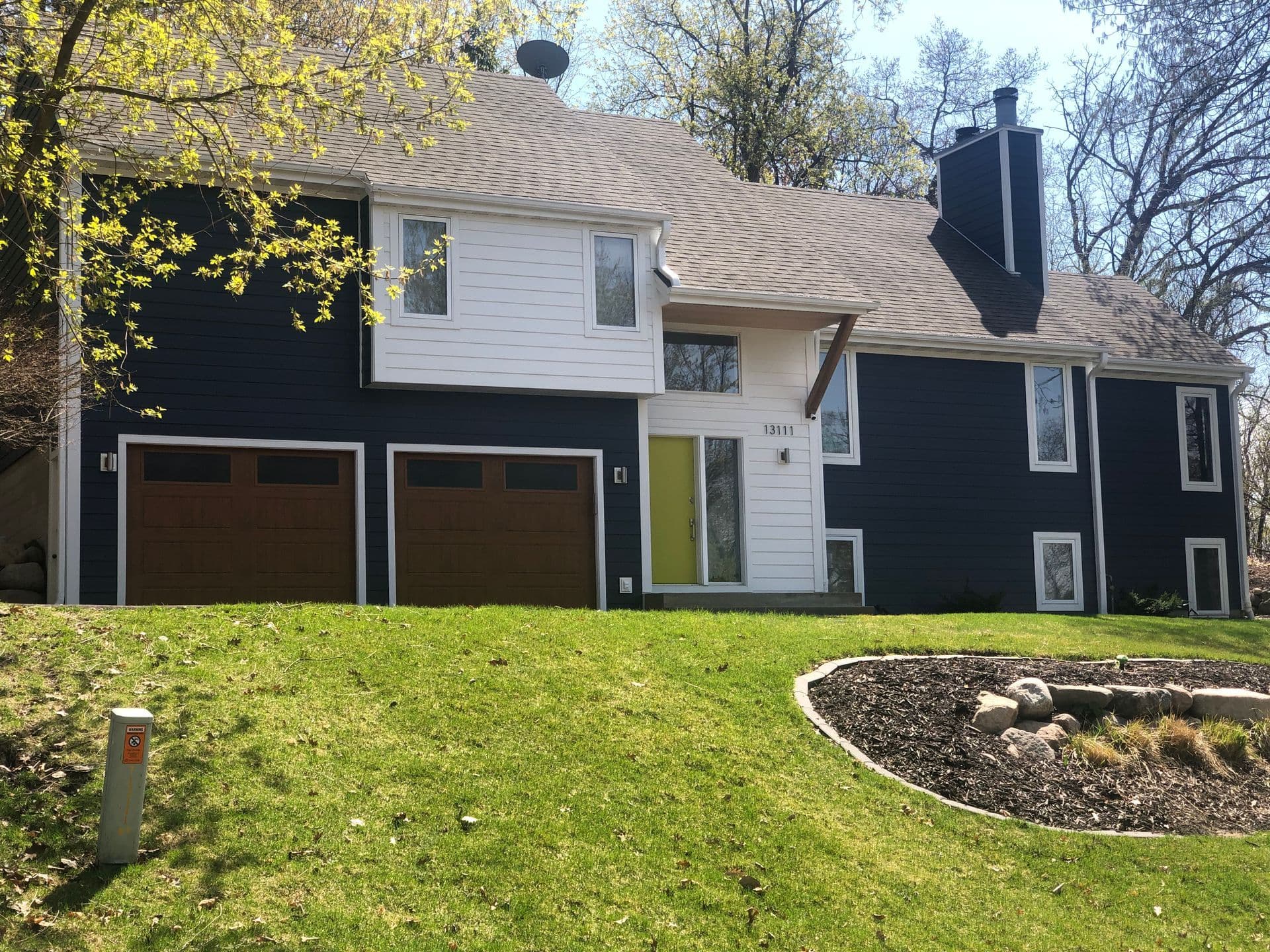
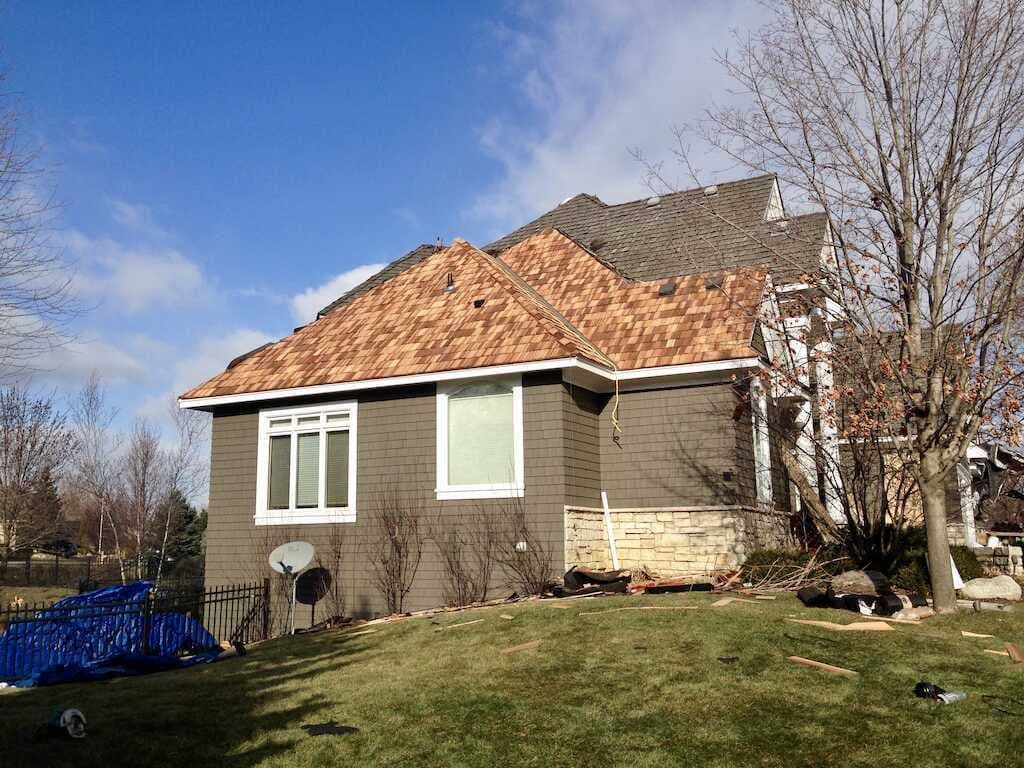
I've installed cedar roofs in Minnesota for years, and I'll tell you up front — fewer homeowners are choosing them now than when I started. A wood roof is beautiful. It's also a real commitment of time, money, and patience, and Minnesota's climate is harder on cedar than most places in the country.
I'm Joe Dvorak. Modern Exterior Systems still installs cedar shake when the home calls for it and the homeowner understands what they're signing up for. But I also have a growing list of customers who started wanting cedar and ended up putting on a synthetic shake that mimics the look without the maintenance and insurance headaches. This post is the conversation I have with them, on paper.
Cedar Shake vs. Cedar Shingles — They're Not the Same Product
People use "shake" and "shingle" interchangeably. They're different.
Cedar shakes are split, not sawn. Thicker, rough, uneven edges. A hand-split shake on a Twin Cities Tudor or a lake home in Excelsior is what most people picture when they say "I want a cedar roof."
Cedar shingles are sawn on both sides. Thinner, smoother, more uniform — closer to what you'd see on a historic Cape Cod or older homes in Lowry Hill.
Both are typically Western Red Cedar or Alaskan Yellow Cedar. Both come in grades from the Cedar Shake & Shingle Bureau, and the grade matters more than most homeowners realize. The grading runs slightly different for shakes vs. shingles, but the lifespan story is the same:
| Grade | What it is | Lifespan in MN |
|---|---|---|
| Premium Grade (shakes) / #1 Blue Label (shingles) | 100% edge grain, 100% heartwood, 100% clear — no flat grain permitted | 25–30 years |
| #2 Red Label (shingles) | Mix of edge and flat grain, some defects allowed | 15–20 years |
| #3 Black Label (shingles) | Utility grade, lots of defects | 10–15 years |
If a contractor quotes "cedar shake" without specifying the grade — or refuses to put it in writing — that's a yellow flag. The difference between Premium and #3 on the same home can be 15 years of lifespan and 30 percent of the price. The bundles ship with a Certi-label tag from the Bureau; ask to see it before the install starts.
Real Lifespan in Minnesota — Not the Manufacturer Number
Cedar manufacturers like to say 30 to 50 years. That's a Pacific Northwest number, not a Minnesota number.
Here's what I see in the Twin Cities doing cedar tear-offs:
- South-facing, full sun, no tree cover: 15 to 22 years. UV dries the wood, oils leach, shakes cup and crack.
- North-facing, under trees: 12 to 18 years. Moss, algae, lichen. Constant moisture means rot.
- East or west, average exposure, decent maintenance: 20 to 30 years if you've been religious about treatment.
I've torn off 15-year-old Premium-grade cedar on a north slope that was already gone, and worked on 35-year-old #2-grade on a shaded east slope that still had life. Aspect and maintenance matter as much as the grade.
Fire Treatment — Class A Is the Floor in More and More Jurisdictions
Untreated cedar is Class C or worse. That's a problem in suburbs that have moved to Class A requirements, and the list keeps growing.
To get cedar even close to Class A, the shakes have to be pressure-impregnated with fire retardant at the mill — not brushed on at install. Treated cedar is technically called Certi-Guard or "fire-retardant treated wood" and ships with its own grade tag. The treatment adds roughly 15 to 25 percent to material cost and changes how the cedar weathers (treated grays a little faster).
Worth knowing: even pressure-treated wood shake by itself only reaches Class B in many tests. To hit a true Class A, you typically need treated shakes installed over a Class A underlayment assembly (an asphalt cap sheet or equivalent). That's how California's Wildland-Urban Interface code handles it. (CSSB Certi-Guard reference here.)
In some Twin Cities jurisdictions you legally can't install untreated cedar on a full reroof. In other parts of the country wood roofs are banned outright — Boulder County, Colorado prohibits new wood shake roofs entirely, and California's WUI zones require Class A assemblies on every reroof. Twin Cities isn't there yet, but the trend isn't slowing down. Even where untreated cedar is still allowed, your carrier may not write the policy. We call the city before quoting — make sure whoever you hire does too.
The Maintenance Reality — This Is Where Homeowners Get Surprised
A cedar roof isn't a roof you install and forget. Treat it like asphalt and you'll lose 8 to 10 years of lifespan.
The rhythm I tell every cedar customer to expect:
- Every 1 to 2 years: Clear debris from the keyways. Pine needles and leaves trap moisture — that's where moss starts.
- Every 5 to 7 years: Apply a treatment (call it stain, preservative, or oil). It replaces the natural oils the cedar has lost to UV. Industry pricing runs $1.50 to $4 per square foot for a professional cedar roof treatment — call it $4,500 to $12,000 on an average Twin Cities home depending on size, pitch, and stain product. (Yes, that's a wide range; the variance is real.)
- Every 8 to 12 years: Moss treatment if you've got tree cover. Zinc strips at the ridge help. Don't pressure-wash a cedar roof — I've seen homeowners blast 5 years of lifespan off in an afternoon. (Soft-wash only, never pressure — our cedar shake roof cleaning + moss treatment + re-stain protocol covers exactly how it should be done.)
Add the treatment cycles over 25 years and you're easily spending another $15,000 to $40,000 on top of the install. That's the cost of owning it — and the part most contractors don't put on the quote sheet. (The cedar shake roof cost guide for Minnesota lays out install + maintenance + insurance impact as one combined lifetime number.)
The Insurance Problem Nobody Warned You About
This is the conversation that's been changing fast in Minnesota, and it's why cedar gets harder to recommend every year.
Twin Cities carriers have been quietly tightening on wood roofs since roughly 2020. After the bigger hail years (June 2023 was brutal in the western suburbs), some carriers stopped writing new policies on cedar-roofed homes entirely. Others raised deductibles to 2 to 5 percent of dwelling coverage specifically for cedar. A few have non-renewed existing policies when the cedar passes 15 years. The roofing companies that focus on cedar in this market have full case files of non-renewal notices from homeowners in Stillwater, Edina, Eagan, and Woodbury — I've seen homeowners hit with $10,000+ annual premium spikes just to keep coverage at renewal. (Anchor Roofing MN has documented the pattern in detail.)
I won't name a specific carrier as "the one that refuses cedar" — the underwriting changes too fast and varies by region. What I can tell you is that big carriers like State Farm, American Family, and Chubb publish premium credits for replacing cedar with Class 4 impact-rated synthetic shake. They're not technically banning cedar, but they're pricing it in a way that encourages replacement. And the Minnesota FAIR Plan — the state's insurer-of-last-resort — does not cover cedar shake. There's no easy fallback.
For context: Minnesota home insurance rates rose 34 percent in 2025, the steepest jump in the country, and 64 percent over the prior two years. Carriers are looking for every reason to limit exposure. Cedar gets flagged.
I've had homeowners in Edina, Wayzata, and Excelsior call me after a non-renewal notice. The answer is usually: replace the cedar with something else, or shop carriers willing to write it — and there are fewer every year.
Before you decide on cedar, call your carrier. Ask if they'll insure a new cedar roof, at what deductible, and whether they'll non-renew at an age threshold. Ask how they pay hail damage on cedar — most carriers now apply 10- to 15-year age limits that automatically convert your policy from RCV (replacement cost) to ACV (actual cash value). On a 12-year-old cedar roof, ACV depreciation can drop your hail payout by half or more. That's the difference between getting a full new roof paid for after a storm and getting maybe a third of one out of pocket.
I'm not an insurance agent. But this comes up enough that I tell every cedar customer to make the phone call before they pick up the pen. (More on the insurance shift in Minnesota here.)
When Wood Still Makes Sense
I'm not anti-cedar. I install it. Here's when it's still the right call:
- Historic homes with cedar on them. A 1920s Tudor in Lowry Hill, a 1908 farmhouse in Stillwater, a lake home that's had cedar for three generations. Synthetic doesn't always look right on these — the proportions, the way it sits on dormers.
- HOA or historic district requirements. Some Twin Cities neighborhoods have covenants requiring cedar. If that's you, we'll do it right.
- Lake homes where the look is the whole point. Hand-split shake on a Lake Minnetonka home is its own thing. Synthetic can come close. Not the same.
- Homeowners who genuinely want to do the maintenance. Some people enjoy the upkeep. If that's you, and you've made peace with the insurance question, go for it.
Modern Alternatives — What I Recommend Instead, and When
A few products have gotten genuinely good at mimicking cedar without the headaches. The three I install most often when a homeowner wants the look but not the commitment:
- CeDUR Synthetic Shake. Polyurethane composite. Looks like hand-split shake from the ground. Class A fire, Class 4 impact, 50-year warranty. No treatment, no insurance complications. Costs roughly the same as a high-end cedar install but eliminates the maintenance spend.
- DaVinci Synthetic Slate and Shake. Engineered polymer. Bellaforte and Multi-Width Shake lines target the cedar market. Slightly more uniform than CeDUR — closer to a sawn shingle than a split shake. If the price has you flinching, I ran the DaVinci affordability math against premium asphalt so you can see when the premium actually earns its keep.
- Stone-coated steel (DECRA, etc.). Steel panels with a textured stone coating. Lighter than cedar, Class A, Class 4. Works best on homes where the roof isn't the focal point.
I won't tell you any of these are "indistinguishable" from cedar. They're not — a trained eye 10 feet away can tell. But from the curb, from a drone, from across the lake, they read as cedar and they hold their look for 40+ years without the treatment cycles. (More on the alternatives here.)
What I Don't Love About Cedar Roofs
In the spirit of being honest:
- The price-to-lifespan math is rough in Minnesota. Premium cedar runs $20 to $30 per square foot installed in the Twin Cities. On a 30-square home that's $60,000 to $90,000 — for a roof that might last 20 years with discipline, or 15 without. The same money in synthetic gets you 50 years and no maintenance bill.
- The insurance situation is getting worse, not better. I don't see carriers softening on cedar. I see them tightening.
- The maintenance is real and people forget. Homeowner treats it once at year 6, forgets at year 12 because life happens. By year 15 the roof looks 25.
- Cedar from the big-box yards isn't what cedar used to be. Old-growth premium is harder to source. A lot of what's on the market is younger-growth wood that doesn't hold up the same way.
If you've read this far and you still want cedar, you're probably the right customer for it. (More disadvantages of cedar here.)
The Bottom Line From a Guy Who Installs It
If your home calls for cedar — historic, architecturally specific, lake home, HOA requirement — I'll install it, and I'll install it right. Premium grade, Class A fire treatment when required, proper ventilation, copper or stainless flashings, ice and water in the right places. Lifetime workmanship warranty (for as long as you own the home), and we register the material warranty in your name at closeout.
If your home doesn't specifically call for cedar — you wanted it for the look but you're flexible — I'll walk you through what CeDUR or DaVinci would cost on your roof. Most of the time, the math points to synthetic. Sometimes it doesn't. The conversation is worth having before you sign anything.
We're CertainTeed ShingleMaster, Malarkey Emerald Pro, Atlas Pro+, LP SmartSide and James Hardie certified, an A+ rating with the BBB (ID 1016569), MN License #BC762305. Cedar, synthetic, asphalt — we'll tell you honestly what fits your home.
FAQ
How long does a cedar shake roof last in Minnesota?
Realistically 15 to 25 years depending on aspect, exposure, and maintenance discipline. South-facing slopes in full sun give up first (15 to 20 years). North-facing under trees fight moss and rot (12 to 18 years). With Premium-grade cedar, Class A fire treatment, treatment every 5 to 7 years, and good attic ventilation, you can push to 25 to 30 years. The "30 to 50 year" manufacturer numbers are Pacific Northwest, not Minnesota.
What's the difference between cedar shake and cedar shingle?
Shakes are split — thick, rough, irregular, old-world look. Shingles are sawn — thinner, smoother, more uniform. Shake is what most people picture when they say "cedar roof." Shingle is what you'd see on a historic Cape Cod. Both come in grades from Premium (#1 Blue Label) down to utility (#3 Black Label).
Will my insurance carrier cover a new cedar roof in Minnesota?
Maybe — and the answer gets worse every year. Some Twin Cities carriers won't write new cedar policies at all. Others will, with elevated deductibles (2 to 5 percent of dwelling coverage), 10- to 15-year age thresholds, and automatic ACV (depreciated payout) instead of RCV on storm claims. The Minnesota FAIR Plan does not cover cedar shake, so there's no insurer-of-last-resort fallback. Always call your carrier before signing — get the answer in writing.
How much does a cedar roof cost in the Twin Cities?
Premium-grade cedar shake with Class A fire treatment typically runs $20 to $30 per square foot installed. On a 3,000 square foot roof that's $60,000 to $90,000, plus another $15,000 to $40,000 in re-treatment over 25 years if you do it right. Synthetic shake (CeDUR, DaVinci) often costs the same to install but eliminates the maintenance spend entirely.
Do I really need to treat a cedar roof?
Yes, for the full lifespan. Cedar's natural oils leach out under UV. Without re-treatment every 5 to 7 years, the wood dries, cracks, and curls. Untreated cedar loses 8 to 10 years of lifespan compared to treated.
Is synthetic shake really as good as real cedar?
From the curb, modern synthetics (CeDUR, DaVinci) look very close — most people can't tell at normal viewing distance. Up close, a trained eye can. Performance-wise, synthetics beat cedar in Minnesota: Class A fire, Class 4 impact, 50-year warranty, no treatment cycles, no insurance complications. For historic or HOA situations, real cedar wins. For homes that just want the look, synthetic usually wins on the math.
Ready for an honest conversation about your roof? Call Modern Exterior Systems at 952-206-6339 or request a free estimate online. We'll measure everything, walk you through cedar and the alternatives, and give you a detailed written quote — no pressure. Whether your home calls for cedar or you'd be better served by a synthetic, we'll tell you straight.
Roof replacement in Minneapolis and the Twin Cities · Cedar shake roof replacement · CeDUR synthetic shake · DaVinci synthetic slate and shake
Modern Exterior Systems is a women-owned roofing and exterior contractor based in Eden Prairie, MN, serving the Twin Cities metro. CertainTeed ShingleMaster, Malarkey Emerald Pro, Atlas Pro+, LP SmartSide, and James Hardie certifications. Lifetime workmanship warranty (current owner). an A+ rating with the BBB. MN License #BC762305.