


I've been doing storm assessments across the Twin Cities for 20+ years — Eden Prairie, Edina, Minnetonka, Plymouth, Maple Grove, Chanhassen, all the way out to Elk River and back. The August 11, 2023 hail event that ripped through Plymouth, Golden Valley, St. Louis Park, Edina, and south Minneapolis put me on a lot of roofs that fall. The July 31–August 1, 2024 event did the same. I've walked thousands of properties after hail and straight-line wind events, and I can tell you the single most common mistake homeowners make in the first 24 hours after a storm.
They climb the ladder.
Don't. I'll get to why in a minute. But before any of that, let me give you the actual playbook — the one I'd give my own mom if she called me the morning after a storm and asked, "Joe, what should I do?"
This is a ground-level walkthrough. Everything in here you can do standing on your lawn in your shoes. No ladders. No roofs. No drone. Just your eyes, a phone for photos, and 20 minutes.
The Short Answer
After a storm, you want to do three things, in this order:
- Walk the perimeter of your house. Look down first, then look up.
- Walk the inside. Specifically ceilings, attic if it's safe to access from the floor, and around windows.
- Decide whether to call your insurance, a contractor, or both.
The goal of this walkthrough is not to diagnose your roof. Your roof is a contractor's job. The goal is to figure out whether you've got enough visible evidence to justify a call.
A Quick Word About Door-Knockers
The morning after any decent hailstorm in the Twin Cities, your doorbell is going to ring. Sometimes within hours. These are storm chasers, and they show up in waves out of trucks with out-of-state plates.
Some of them are legitimate national companies. Most are not.
Do not sign anything at the door. Not a "free inspection authorization." Not a "contingency agreement." Not a piece of paper that says they can talk to your insurance carrier on your behalf. That signature is the most expensive thing you'll do all week if it's the wrong company.
If they push hard, ask them to come back after you've called your insurance. The good ones will say "of course." The chasers will get aggressive. That's your filter.
And one thing I'll add because Minnesota law is specific on this: in MN, it's illegal for a residential contractor to advertise, promise, or pay — directly or indirectly — any portion of your insurance deductible as an inducement to sign with them (MN Statute 325E.66). That same statute also bans contractors from offering you any compensation in exchange for letting them inspect, for making the claim, or for referrals. If anyone at your door offers to "cover the deductible," "make the deductible disappear," or hands you a "free gift card" for the inspection, they're either lying to you or breaking the law. Or both. Close the door.
The Minnesota Department of Labor and Industry enforces this one, and the Minnesota Department of Commerce has been warning homeowners about out-of-state storm chasers for years. The pattern is the same every storm season — non-Minnesota plates, unfamiliar company names, pressure to sign today, and an "Assignment of Benefits" form that hands your claim rights over to them. Don't sign one. Ever.
What You CAN Safely Check From the Ground
Here's the actual checklist. I'd start in the front yard and work your way around the house clockwise. Bring your phone. Take photos of everything you notice, even if you're not sure it's damage. Time-stamped photos are gold if you end up filing a claim.
1. Debris on the lawn
Walk the yard. Look for:
- Shingle pieces — full shingles, half shingles, or even small dark fragments. After a wind event, you'll find these. After a big hail event, you might find granule clusters that look like sand.
- Branches and limbs — anything bigger than your forearm is worth photographing where it landed.
- Pieces of siding — chunks of vinyl, wood, or LP SmartSide blown off your wall or a neighbor's.
- Gutter or downspout sections — sometimes they get ripped clean off.
- Insulation or attic debris — if you see fiberglass insulation in the yard, that's usually a sign something opened up on the roof or in the attic vents.
Photograph it where it sits. Don't clean up yet.
2. Granules in the gutters and at the downspouts
Walk to where each downspout drains. Look at the splash pad or the ground around it. You're looking for what looks like coarse black or gray sand — that's asphalt shingle granules washed off your roof.
A small amount is normal, especially on a roof that's a few years old. A heavy concentration — enough that the ground looks gritty or you can scoop a handful — usually means significant impact happened up top.
If you can safely look into your gutters from a window above (no ladder), do that too. Heavy granule accumulation in the gutter trough is a classic post-hail sign.
3. Dented gutters and downspouts
Walk slowly around the perimeter and look at the gutters from below. Round, dimple-like dents in the aluminum face are usually hail impacts. Hail hits the gutter on the way down, leaves a clean circular dent. (Wondering whether the storm was big enough to matter? See what size hail will damage a roof — quarter-size is the threshold.)
Downspouts get the same treatment — look for round dents on the front-facing side, especially on the side of the house that faced the wind. If your downspouts have separated at the seams or sections are bent, that's wind, and it matters too. (See our Minneapolis gutter repair page for seam-leak and pulled-downspout scopes.)
One thing worth knowing: most experienced adjusters don't start on the roof. They start with what we call "soft metals" — gutters, downspouts, vent caps, AC condenser fins, the metal cap on top of your mailbox post. Those surfaces dent easily and hold the exact impression of a hailstone. If your gutters and your AC fins are dented, that's strong supporting evidence the roof got hit too, even before anyone climbs up to confirm. Document those carefully.
4. Dented or punctured roof vents and exposed metal
This one's tricky because you can't see the roof. But you can usually see the tops of furnace vents, exhaust fans, plumbing stacks, and ridge vents from the ground if you walk far enough back from the house.
Use your phone camera and zoom in. You're looking for:
- Round dents on metal vent caps
- Cracked plastic vent housings
- A turbine vent (the spinning ones) that's bent or no longer spinning
- A ridge vent that looks like it's lifted or torn
Vent damage is one of the strongest indicators that the shingles got hit too, because vents stick up higher and catch hail first.
5. Damaged siding
Now turn your eyes to the walls. Walk slowly, sun behind you when possible, and look across the face of the siding at a low angle. You're looking for:
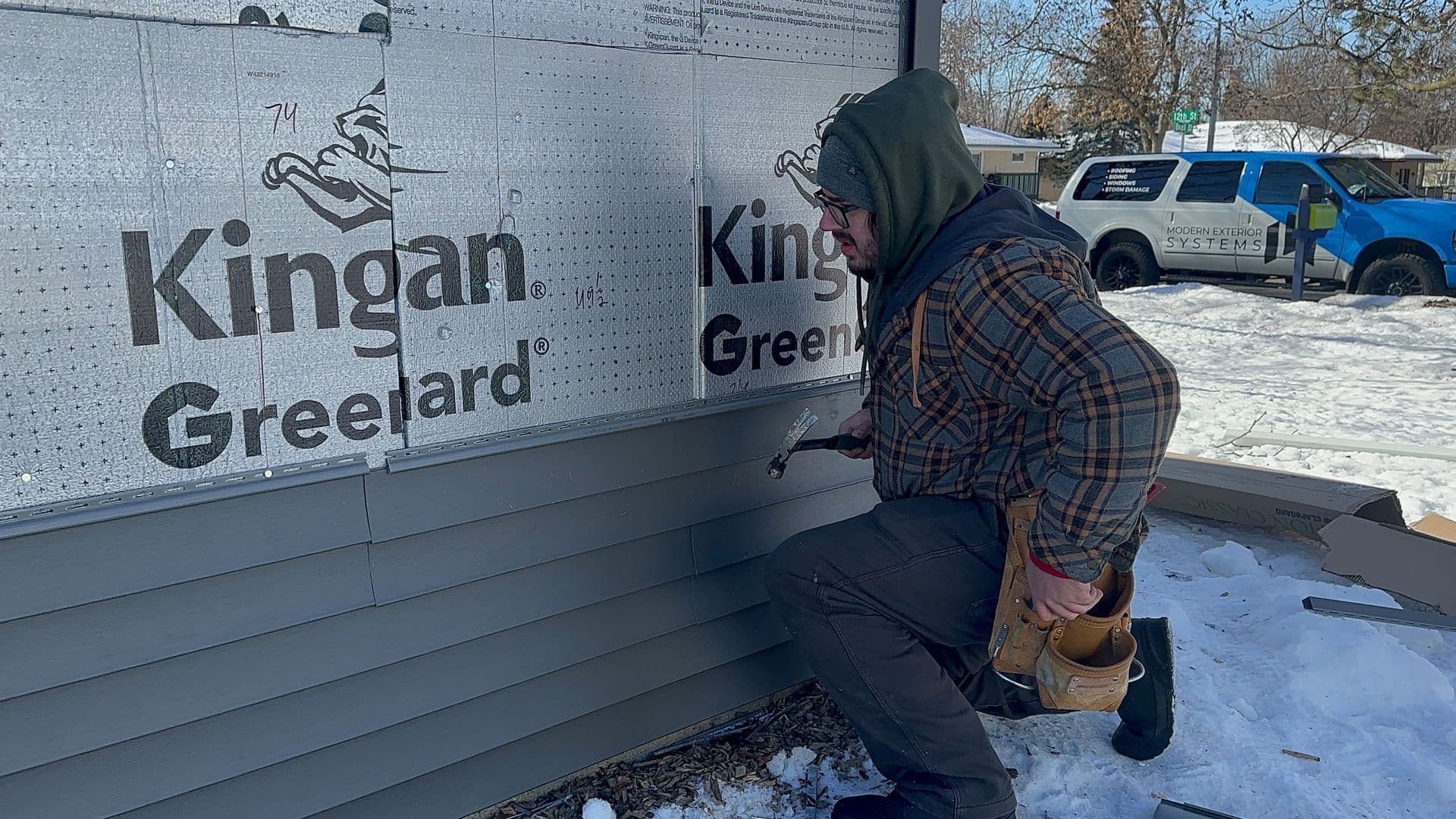
- Cracks in vinyl panels — vinyl gets brittle when it's cold, and a hailstone in February can crack panels that would have survived in July
- Dents in steel or aluminum siding — same deal as gutters, round impact marks
- Holes punched through fiber cement or LP SmartSide — less common, but happens with large hail
- Panels that have come loose or are flapping in the wind — that's a wind issue
- Missing chunks at corners or around windows
Pay special attention to the west and north walls in the Twin Cities — that's where most of our storm energy comes from. South and east walls usually take less of a beating.
6. Missing or lifted shingles you can see from the yard
Walk to the far side of your yard, the farther the better. Look up at the roof from across the property if you can. You're looking for:
- Dark patches where shingles look like they're a different color than the rest — usually that's the asphalt mat underneath, exposed because the surface shingle blew off
- Shingles that look raised or curled along their edges
- Missing tabs or full shingles in a clear line — that's wind damage, and on a Twin Cities roof after a 50+ mph gust (NOAA's threshold for asphalt-shingle roof damage), this is common
- Shingles in your yard that you already photographed — match them to the roof if you can see where they came from
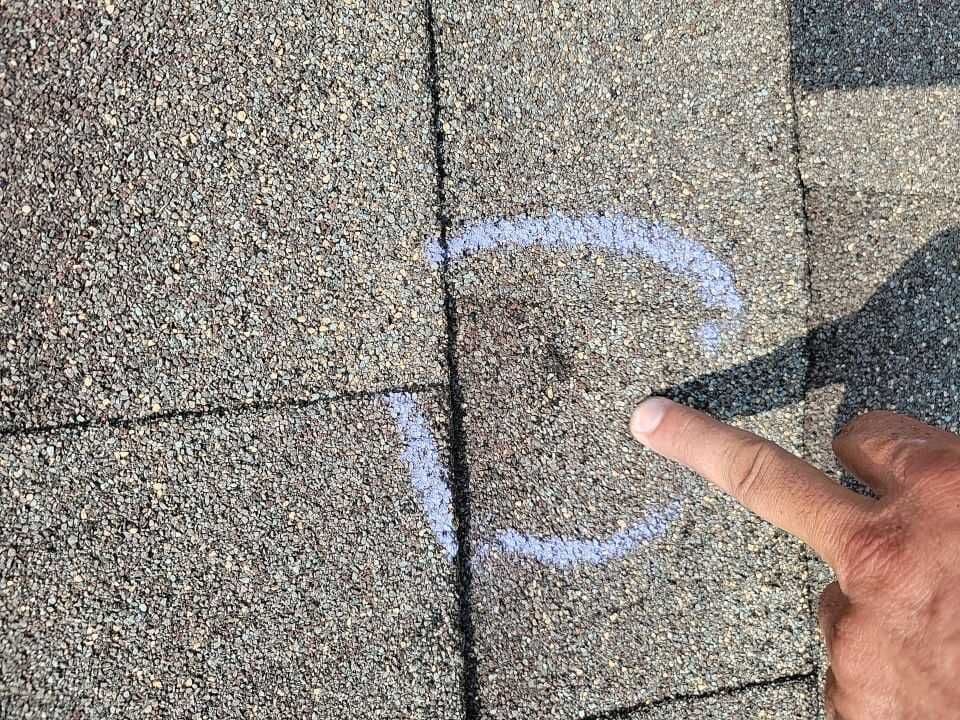
What you won't see from the ground: bruising, cracked mat, granule loss on individual shingles, broken sealant strips, or hail dings on shingles that didn't lose granules. Bruising in particular is the one most homeowners miss — it's a fractured shingle mat under the granules that looks intact but feels soft to the touch, like a bruise on an apple. That's only catchable hands-on. Don't try to fake it from the ground.
7. Window damage
Walk around the perimeter and check every window from the outside. Look for:
- Cracked or broken panes
- Spider-web cracks that don't go all the way through (impact damage)
- Torn screens
- Damaged frames, capping, or trim
Then go inside and check the same windows from the interior side. Sometimes a window looks fine from outside but you can see a hairline crack from in.
8. Doors and garage doors
Check entry doors, storm doors, and the garage door. Garage doors take wind hits hard because they're a big flat surface. Look for:
- Panel dents (especially on metal garage doors)
- Bent tracks
- Broken weatherstripping
- A garage door that doesn't open smoothly anymore
If hail or wind took out your entry or patio door, door installation cost in Minnesota (entry, patio, storm) lays out 2026 replacement ranges so you know what to expect on the claim.
9. AC unit, deck, fence, outdoor furniture
These aren't roof damage, but insurance covers them and adjusters want to see them. Photograph dents on the AC condenser fins, cracked deck boards from large hail, dented fence panels, broken patio furniture.
What You CAN Check From Inside
Don't skip this part. Some of the most important storm evidence is indoor.
1. Ceiling stains
Walk every room. Look at the ceiling. You're looking for:
- Yellow or brown stains — water has come through at some point
- Bubbling paint or sagging drywall — active or recent water intrusion
- Drip marks on light fixtures or down walls below the ceiling line
If you see a fresh wet spot, photograph it and put a bucket under it.
2. Attic check (only if safe from the floor or pull-down stairs)
If you have an attic access from inside your house — a hatch, pull-down stairs, or a walk-up — open it. Don't climb up into the attic itself unless you know what you're doing and have a flashlight and proper footing. Just stand at the opening and look.
You're looking for:
- Daylight visible through the roof deck — that's a hole, and it's a big problem
- Wet wood or wet insulation
- Stains running down rafters
- Granules in the insulation — they sift down through cracks after impact
3. Around windows and doors
Check the interior trim around every window and exterior door. Run a finger along the seam between the trim and the wall. Damp? Stained? That's water getting in somewhere.
What NOT to Do
I'm going to say this twice because it matters.
Don't climb your roof. I don't care if you've done it before. I don't care if your buddy has a ladder. After a storm, your roof has loose granules, possibly broken shingles, possibly nails sticking up, and almost certainly a slipperier surface than it had before the storm. Every year someone in the Twin Cities falls off their own roof doing exactly this. Falls from height are the leading cause of residential construction fatalities, and you're not a residential construction worker.
A real contractor walks roofs for a living, has fall protection training, and has insurance for when something goes wrong. You have none of that. Stay on the ground.
Don't climb a ladder to inspect. Same problem, slightly lower stakes. Even if you just want to "peek into the gutter," skip it. Use your phone camera zoom, or wait.
Don't sign anything from a door-knocker. I said it earlier. Saying it again because this is where homeowners get hurt most.
Don't get on the phone with your insurance carrier before you've documented your damage. Take your photos first. A claim conversation goes better when you can describe specifics.
Don't pay anything up front for a "claim guarantee" or "approval guarantee." Nobody can guarantee what your carrier will approve. Anyone who tells you otherwise is selling you a story.
Don't tarp the roof yourself. If you have an active leak and water is coming in, get a bucket under it, move furniture, and call a contractor for an emergency tarp. Climbing onto a wet, recently-damaged roof to attempt your own tarp job is how people get hurt.
Cosmetic Damage vs. Claim-Worthy Damage
Here's where homeowners get confused, and where storm chasers exploit them.
Cosmetic damage is damage that affects appearance but not function. Examples:
- Small dents on aluminum gutters that don't leak
- Granule loss on a young, healthy shingle that doesn't expose the mat
- Hail dings on a steel siding panel that's still watertight
- Scuff marks on a garage door panel
Cosmetic damage may or may not be covered depending on your policy. Some carriers cover it. Many exclude it explicitly with a "cosmetic damage exclusion" rider, especially on metal roofs and siding.
Claim-worthy damage is damage that affects function and shortens the useful life of the material. Examples:
- Cracked or punctured shingles
- Granule loss heavy enough to expose the asphalt mat
- Hail bruising that's softened the shingle mat (this is what a contractor checks for hands-on)
- Wind-lifted shingles where sealants have broken
- Punctured siding
- Cracked window panes
- Damaged flashings or vents
This is the line your insurance adjuster is going to walk. And honestly, most homeowners can't tell the difference from the ground — and that's fine. Your job in this walkthrough is to document everything you can see. Let the contractor and the adjuster sort out which side of the cosmetic-vs-functional line each item falls on.
Should You Call Insurance First, or a Contractor First?
This depends on your situation.
Call a contractor first when:
- You're not sure if you have damage worth claiming
- You want a professional assessment before deciding whether to involve insurance
- You're past your roof's 10-year mark and you're worried about depreciation (more on this in a minute)
- You want to understand what a claim might actually pay for
Call insurance first when:
- You have obvious, significant damage (missing shingles you can see from the yard, broken windows, water actively coming in)
- A tree is on the house
- You have an emergency leak and need emergency tarping
- You're certain you want to file regardless of contractor input
There's no wrong answer. But here's the thing most door-knockers won't tell you: filing a claim is not free. Claims affect your premium, your renewal, and your record. If your damage is borderline, a contractor inspection first can save you a claim you didn't need to file.
The 10-Year Roof Insurance Reality
If your roof is approaching or past 10 years old, you need to know something about how Twin Cities insurance has shifted.
Most carriers now permanently reduce your roof's Replacement Cost Value once it crosses 10 years. A 12-year-old roof that gets hit might only pay out at 70-80% of full replacement value — even on an "RCV" policy. The depreciation gap can be tens of thousands of dollars on a Twin Cities home.
That changes the math on whether to file. If you've got significant damage on a 12-year-old roof, you may still want to file — but go in knowing the check is going to be smaller than you'd expect, and a contractor who actually works claims regularly can walk you through what to expect.
I wrote a detailed piece on this — ACV vs RCV on Minnesota roof claims — if you want the full breakdown.
When to Call Modex
Here's how I think about it. If your walkthrough turned up:
- Granules in the gutters or at the downspouts
- Dented gutters, downspouts, or vents
- Any visible shingle damage from the ground
- Siding damage
- Indoor water stains or attic intrusion
- Anything you photographed and aren't sure about
Call us. A ground-and-roof inspection from a real contractor is free, doesn't obligate you to anything, and gets you a written assessment you can use for insurance or for your own decision-making.
What I'll do: walk the roof myself, check the things you can't see from the ground, photograph everything, give you a written report, and tell you honestly whether you have damage worth filing on. If you don't, I'll tell you that too. I've talked plenty of homeowners out of filing claims they didn't need to file.
Phone: 952-206-6339. Or use the free inspection request form and we'll call you back within the business day.
For more on what to do in the first 48 hours, here's the Twin Cities playbook. For visual reference on what hail damage actually looks like on a MN roof, here's a photo guide. And if you've decided to file, here's the step-by-step on filing a roof insurance claim.
FAQ
How long after a storm do I have to file an insurance claim in Minnesota?
Most Minnesota homeowner policies require you to file within a reasonable time after damage occurs, and many carriers specify one year from the date of loss. Some are stricter — six months. Check your policy or call your agent. The sooner the better, regardless. Storm damage gets worse with every subsequent rain.
Can I just file based on hail in the area, even if I don't see damage?
No. You need actual damage on your property to have a valid claim. Hail being reported in your zip code is good supporting context, but the claim itself is based on what's on your house. That's another reason a contractor walk is worth doing — they'll find damage you can't see, or confirm there isn't any.
Will my insurance go up if I file a hail claim?
It can. Hail and wind claims are typically considered "catastrophic" or "act of God" claims in Minnesota and have less impact on premiums than at-fault claims (like fire from your stove or water damage from a burst pipe you didn't catch). But carriers do track frequency, and multiple claims in a short window can affect renewability. Your agent can tell you exactly how your carrier handles it.
Do I need to get on the roof myself to assess damage?
No. Please don't. Roof inspection is a contractor's job, and any real storm damage assessment from a reputable contractor is free and obligation-free. You doing it yourself risks injury and won't get you a usable assessment for insurance anyway.
What if a contractor at my door is offering a "free inspection" right now?
Be skeptical. Real contractors do free inspections, but they're not pressuring you on your doorstep the morning after a storm. Get the company name, check their Minnesota contractor license (search the MN Department of Labor and Industry license lookup), check their BBB rating, and check whether they're actually a Twin Cities-based business or a roving out-of-state crew. If they pressure you to sign anything that day, that's your answer.
What's the difference between hail damage and wind damage on an insurance claim?
For your insurance, the distinction matters for how the adjuster scopes the loss. Hail damage tends to be widespread and surface-level (bruising, granule loss, dents). Wind damage tends to be concentrated and structural (missing shingles, torn flashing, lifted sealants). Many storms cause both, and a good contractor will document each separately. More detail on each: hail damage and wind damage.
Bottom Line
The post-storm walkthrough is about three things: stay safe, document what you can see, and don't sign anything in the first 24 hours.
Everything else can wait. Insurance can wait. Decisions can wait. The roof is going to be there tomorrow.
What you want in the first day is photos, notes, and a clear head. The contractor walks the roof, the adjuster scopes the loss, and the decisions get made with real information instead of doorbell-pressure.
If you want a real contractor walking your property — not pressuring you, not signing you up for anything — call 952-206-6339 or request a free storm inspection. We serve Eden Prairie, Minneapolis, St. Paul, and 90+ Twin Cities communities, and we've been doing this for decades.
For service-specific information, our Minneapolis storm damage roof repair page covers our process, scope of work, and pricing structure. And if you want to skip ahead to a detailed assessment article with even more depth on what to check and when, here's the full storm damage assessment guide.
Modern Exterior Systems is a women-owned, family-operated roofing and exterior contractor based in Eden Prairie, MN, serving the Twin Cities metro. Owner Joe Dvorak brings decades of hands-on construction experience, CertainTeed ShingleMaster and Malarkey Emerald Pro certifications, and a LIFETIME workmanship warranty to every project. an A+ rating with the BBB.