

I install synthetic slate roofs on Twin Cities homes — DaVinci is the line I put up most often — but I do not install natural slate. Real slate is a niche trade. There are maybe a handful of guys in Minnesota who still do it well, and I'll tell you straight up when you actually need one of them versus when synthetic gets you 95% of the same look for half the headache.
This post is the answer to a question I get a couple times a year at the kitchen table: "What's actually inside a slate roof?" Homeowners see a slate roof on a house in Edina or on the old stone houses near Lake of the Isles and they want to know what's under those tiles. Why does it last a century. Why nobody's building new ones from scratch around here. Whether the synthetic version is the same thing or a cheap copy.
Here's the honest breakdown — from the roof deck up to the cap.
The Short Version
A real slate roof is layered like this, from the wood deck up:
- Roof deck (plywood or board sheathing)
- Ice and water shield at eaves, valleys, and penetrations
- High-temp synthetic underlayment across the field
- Copper or stainless steel flashings at every transition
- Hand-nailed natural slate tiles in a staggered pattern, with copper nails
- Ridge and hip caps (usually slate or a metal cap)
Each layer does a specific job. The reason slate roofs last 100+ years is not the slate alone — it is the flashings and the fasteners. Copper outlives everything else on the house. When a slate roof finally fails, it is almost never the slate. It is the steel nails rusting out, or galvanized flashing that should have been copper.
Synthetic slate (DaVinci) keeps the same look and most of the same layering. What changes is the tile itself — engineered polymer instead of quarried stone — plus the structural load on your house and the install crew you need.
Layer 1: The Roof Deck
Every roof starts with the deck. On most Twin Cities homes that's 1/2" or 5/8" plywood or OSB. On the old slate houses around the metro — places built between 1900 and 1940 — the deck is usually solid board sheathing. 1x6 or 1x8 pine boards laid edge to edge.
The deck has to be flat, dry, and structurally capable of carrying the load. This is where natural slate gets complicated in Minnesota.
A natural slate roof weighs 800 to 1,500 pounds per square (a "square" is a 10x10 area, so 100 square feet) — and architectural-grade thick slate runs 1,200-1,600, with estate-grade pushing 2,500-3,000. For comparison, asphalt shingles run 200 to 350 pounds per square. That means a slate roof can put four to five times the dead load on your trusses and walls compared to what is up there now. The National Slate Association publishes the per-thickness weights: 1/4" slate at 9.35 lbs per square foot, 1/2" at about 18.70.
If you're putting natural slate on a home that was originally built for asphalt, you need a structural engineer to evaluate whether your framing can handle it. Period. I have walked away from natural slate conversations more than once because the homeowner didn't want to pay for the structural review or the sister-trussing work that would have been required to do it safely. That is not a corner I will cut.
Synthetic slate avoids this almost entirely. DaVinci composite tiles run about 350 to 380 pounds per square — roughly the weight of a heavy architectural shingle and a quarter of natural slate's load. No structural engineer required on a typical reroof, no framing upgrade, no sleepless nights when you get 18" of wet March snow.
Layer 2: Ice and Water Shield
Above the deck, the next layer is a self-adhering waterproof membrane called ice and water shield. It's a peel-and-stick rubberized asphalt sheet that bonds directly to the deck and seals around every nail that goes through it.
On a Minnesota roof — slate or otherwise — I run ice and water shield:
- At every eave, 6 feet up from the wall line (MN code requires 24 inches past the interior wall plane minimum; I go beyond)
- In every valley, full width
- Around every chimney, skylight, dormer, and pipe penetration
- Along every rake edge in exposure-heavy installs
This is the layer that saves you when ice dams form. Twin Cities homes get ice dams. We have the freeze-thaw climate, the deep snow loads, and a lot of older houses with marginal attic insulation. Ice and water shield is the difference between "we had ice on the roof in February" and "we had ice on the roof in February AND water came down the kitchen drywall."
Slate by itself is waterproof. But water under the slate — wind-driven rain, snowmelt that wicks up under the tiles, condensation from a cold attic — has to be stopped at the deck. That is the ice and water layer's job.
Layer 3: High-Temp Synthetic Underlayment
Across the rest of the field — everywhere that's not covered by ice and water shield — goes a high-temperature synthetic underlayment.
On a natural slate roof you do not use traditional 15- or 30-pound felt. Felt deteriorates in 20 to 30 years. The slate above it is going to last 100+. You will not be back up there to replace the felt before the slate finally wears out. Cheap underlayment under a century-rated roof is the dumbest possible move.
The right call is a heavy-weight synthetic underlayment rated for the lifespan of the slate. Some installers use 30-pound mineral-surfaced roll roofing or specialty slate underlayments. Either way you want something rated 180-degree temperature resistance minimum and a service life that matches or exceeds the slate above it.
On synthetic slate (DaVinci) the underlayment requirement is less extreme because the warranted life of the tile itself is 50 years instead of 100+. A premium synthetic underlayment rated for 30+ years works fine.
Layer 4: Flashings — Copper, Not Galvanized
This is where slate roofs are either built to outlive the homeowner or built to fail in 25 years. The flashings.
Every transition on a roof — valleys, sidewalls, chimneys, skylights, plumbing vents, the step flashing where the roof meets a brick chimney — has to be flashed in metal. On a slate roof, that metal should be copper or stainless steel. Never galvanized steel. Never aluminum. The National Slate Association spec calls for minimum 16 oz copper (ASTM B 370) at all flashings and bib repairs.
Why: a natural slate tile is going to last 100 to 200 years depending on the quarry. Galvanized flashing rusts out at 20 to 30 years. Aluminum fails at corroded contact points where it touches mortar or the wrong fastener. If your flashing dies in year 30, the whole roof has to come off to redo it. You just turned a 100-year roof into a 30-year roof because somebody saved $1,500 on flashing material.
Copper itself is not infinite. Field copper flashings run 80 to 100 years; valley copper, which takes the most water and abrasion, can start to pit and leak at 60 to 70. But here's the key — copper can be replaced as a discrete maintenance event without tearing off the slate. Galvanized cannot. That's why copper or stainless is the only correct call. Those are the two materials I'd specify if I were spec'ing a real slate roof — and they're what the legitimate slate installers around here use as standard.
On a DaVinci synthetic slate install I do, I still use a step up from base-grade flashing. Pre-finished aluminum or galvalene is acceptable on a 50-year warranted product. But if the homeowner wants to spend the extra dollars for copper at the chimney and valleys, I'm 100% behind it. Looks better and outlasts the synthetic tile.
Layer 5: The Tiles — Real Slate vs Synthetic
Now we get to what most people think of when they hear "slate roof." The tiles.
Real Slate
Natural slate is a metamorphic rock quarried in specific regions — Vermont, New York, Virginia, Pennsylvania, and historically Wales and Spain. Each tile is split by hand from a larger block. That's why no two slates look identical. The thickness varies slightly, the surface has a natural cleft texture, and the color ranges depending on the quarry: gray, black, green, purple, red, and the famous "weathering" slates that change color over decades.
Lifespan is not one number — it depends entirely on the quarry of origin. The actual ranges, from the National Slate Association and historic-building data:
- Buckingham Virginia slate — 175+ years (the longest-lived in North America)
- Vermont / New York Slate Valley — 150 to 250 years on hard varieties; sea-green Vermont closer to 125
- Pennsylvania hard slate (Chapman, Peach Bottom) — 110 to 160 years
- Pennsylvania soft slate (Lehigh-Northampton black) — 75 to 125 years, sometimes less
- Imported Spanish / Welsh — 100+ years on quality grades
So when someone says "slate lasts 150 years," that's true of Vermont and Virginia. Pennsylvania soft slate is often closer to 75-100 — still better than asphalt, but not the marketing number. Knowing the quarry of origin on a historic Twin Cities slate roof actually matters when you're trying to decide between restoration and replacement.
Slate tiles are typically 18" to 24" long, 9" to 14" wide, and 1/4" to 3/8" thick. They are installed in a staggered pattern with a "headlap" — meaning each tile overlaps the one below it by 3" to 4" so water cannot penetrate the gap. The National Slate Association calls for a minimum 3" headlap on slopes 8:12 and steeper, 4" on lower-pitch roofs from 4:12 to 8:12.
Each tile is fastened with two large-head solid copper nails through pre-punched holes near the top of the tile. Nail length runs roughly twice the slate thickness plus an inch — typically 1 1/2" for field slates and 2" for ridge and hip slates. The nails are driven flush but not over-driven — you do not want the slate cracked under the nail head. The next course covers the nail heads and the cycle continues up the roof.
This is slow, careful work. A skilled natural slate installer might do 1 to 1.5 squares per day. An asphalt crew does 25 to 30. That is why labor on natural slate is so expensive and why the trade has dwindled. The guys who do it well learned from older slate installers, and there are fewer of them every year.
Synthetic Slate (DaVinci)
DaVinci composite slate is molded from a virgin engineered polymer that's UV-stabilized, impact-resistant, and Class 4 hail-rated. Each tile is cast from a real slate master mold — meaning the surface texture, edges, and natural variations are pulled directly from quarried slate. From 15 feet away you cannot tell the difference from natural slate. From the curb you absolutely cannot.
The tiles are typically 18" long, 12" wide, and 1/2" thick with varied edge profiles in the same bundle so the installed roof doesn't look uniform or stamped-out. They install with standard roofing nails (or screws on some applications), in a similar staggered pattern with proper headlap.
A DaVinci roof goes up about 2 to 3 squares per day with a competent crew. Faster than natural slate, slower than asphalt. And critically, it can be installed by any trained premium roofing crew — you don't need the dying slate trade.
The warranty is 50 years on the material, transferable. Real slate has no warranty because nobody's writing a 150-year contract, but the historical track record is what it is.
I have a separate writeup on DaVinci synthetic slate with the line-by-line product details. And a cost guide for Minnesota DaVinci installs so you can see actual ranges, not "it depends" answers.
Layer 6: Ridge and Hip Caps
The top of the roof, where two slopes meet at the ridge, gets a cap. On natural slate, the ridge cap is usually either matched slate tiles cut and installed on edge, or a copper saddle ridge running the length of the peak. Same materials at the hips where two sloped sides meet at a corner.
This is one of the spots where a slate roof either looks fantastic for a century or starts to fall apart in year 40. The ridge takes the most weather. Driven rain, wind uplift, snow load, ice. The cap and the underlying ridge construction have to be over-built relative to the field of the roof.
On DaVinci installs there's a matching synthetic slate ridge cap that ships with the system. Same material, same warranty. Cleanest install path.
Why a Slate Roof Lasts 100 Years (and Why Most Don't)
Here's the honest truth about slate longevity. A slate roof CAN last 100+ years. Most don't. Not because the slate fails, but because somewhere in the layered system, something else fails and takes the roof down with it.
The slate roofs that hit 100+ years all have a few things in common:
- Copper or stainless flashings — 16 oz copper minimum per National Slate Association spec; galvanized cuts the life in half
- Copper nails through the slate — steel nails are the #1 cause of "premature" slate failure (the nails rust out at 30-50 years and slates slide off in pairs)
- A solid deck and structurally adequate framing — slate movement from settling or sag breaks tiles
- Proper headlap and exposure — 3" headlap minimum on steeper pitches, 4" on lower pitch; under-lapped slate leaks
- A maintenance plan — replacing a few broken slates every 20-30 years, re-bedding ridge caps, replacing valley copper around year 60-70 when it starts to pit
If you have an old slate roof on a Twin Cities home and you want to know what shape it's in, the questions to ask are about the nails and the flashings — not the slate. The slate is almost always fine.
How long a roof actually lasts in Minnesota gets into the broader lifespan question across all roofing types.
Why Most New Twin Cities Slate Roofs Are Synthetic
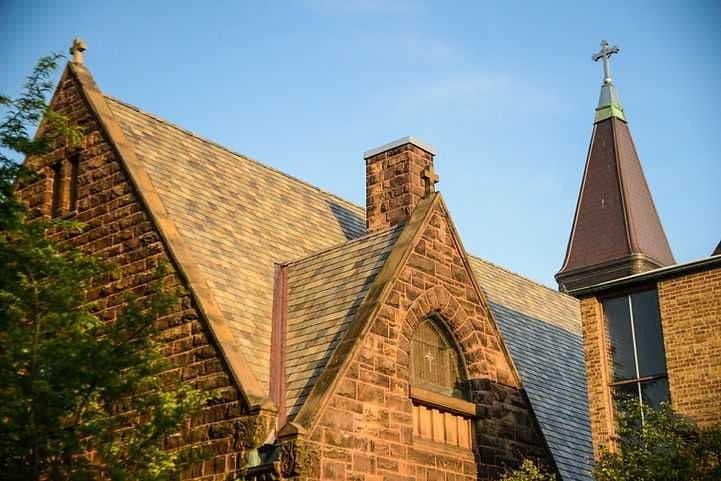
If you drive around Lake of the Isles, Summit Avenue in St. Paul, or older parts of Edina and Wayzata, you'll see real slate roofs that are 70, 80, 100 years old. Those are the originals. They were put up when there was a working slate trade in this region.
Almost nobody is installing new natural slate roofs in the Twin Cities right now. Here's why, in order of how much each one matters:
1. Cost. A natural slate roof in Minnesota runs $50+ per square foot installed — and complex roofs with imported slate and full copper flashing push well past that. On a 30-square (3,000 sq ft) roof that's $150,000+. DaVinci synthetic slate runs $2,500-$3,500 per square installed ($25-$35 per square foot), so $75,000-$105,000 on the same 30-square roof. Same look from the curb. Roughly half the price, and the structural review goes away.
2. Structural load. Most homes built since 1970 cannot carry the weight of natural slate without framing upgrades. Adding $15,000-$30,000 of structural work on top of a $100K+ roof prices it out of reach for almost everyone.
3. Installer availability. I can put together a crew to install DaVinci tomorrow. To do natural slate properly, you need to find one of the few legitimate slate installers in the region and get on their schedule — which can be a year out or more.
4. Hail. Twin Cities hail seasons are brutal. Natural slate is brittle. A bad hail event can damage 20-40% of a slate roof in one storm. DaVinci is Class 4 impact rated — the highest available — and shrugs off most of what we throw at it. Many insurance carriers also discount premiums on Class 4 roofs, which factors back into the long-term cost equation.
5. Repair logistics. A broken DaVinci tile is replaced from stock the manufacturer maintains. A broken natural slate tile from a 1920s quarry may not have a perfect color match available anywhere.
This is why on new installs and full reroofs in the metro, when somebody wants the slate look, I steer them toward DaVinci. It is not a downgrade. It is a different — and in most cases better — engineering decision for this market.
For the broader synthetic-roofing affordability question, my honest take on DaVinci affordability goes deeper. And if you're curious why tile and slate roofs are so much rarer in the U.S. than in Europe, I wrote about that here.
What I Don't Love About Slate Roofs (Real or Synthetic)
I'd be a worse contractor if I told you slate was perfect. Here's where slate — both real and synthetic — falls short.
You can't walk on it. Both natural slate and DaVinci are slippery, and natural slate cracks under careless foot traffic. Any maintenance work on a slate roof — gutter cleaning, chimney inspection, anything — has to be done from a ladder or with proper roof jacks. That's a real ongoing cost over the life of the roof.
Repairs are not DIY. A broken slate tile is a tear-off-and-replace job that touches multiple courses. This is not "go to Home Depot and grab a shingle." It's a specialty repair.
Hail damage on natural slate. I said this above, but it's worth saying again. Natural slate is beautiful and it is brittle. A bad hail event can be catastrophic. If you've got original slate on a historic home in the metro, your insurance situation deserves a separate conversation.
Sticker shock. Even synthetic slate is at the premium end of the roofing market. If your budget is asphalt-shingle pricing, slate is not the right product. There are good architectural and luxury asphalt shingles that look great and perform well — and I install plenty of those too.
Synthetic Slate vs Synthetic Shake — A Quick Note
Sometimes homeowners come in asking about slate when what they actually want is shake. They overlap in the "premium curb-appeal alternative to asphalt" space. The short version:
- Synthetic slate (DaVinci) mimics quarried stone. Sharp angular edges, smooth or cleft surface, formal look. Best on Tudor, Victorian, Colonial, French Country.
- Synthetic shake (CeDUR) mimics hand-split cedar shake. Rough wood-grain texture, irregular widths, warm tone. Best on Craftsman, ranch, lake home, lodge style.
I install both. My CeDUR synthetic shake writeup covers the shake side, and the 5 cedar roofing alternatives I install most often ranks the full shake-look field if cedar aesthetics are what brought you in. They're different products for different home styles — pick the one that matches your architecture, not the one that's trending.
When You Actually Need a Natural Slate Installer
I'll close with the honest answer to "should I just hire a natural slate guy."
You need a natural slate installer when:
- You own a historic home with an original slate roof and you want to repair or restore it (not replace with a different material)
- You're in a historic district with materials requirements that mandate natural slate
- You want a 150-year roof and you have the budget, the structural capacity, and the patience to find the right installer
- You're doing a high-end new build designed from the framing up to carry slate weight
You do NOT need a natural slate installer when:
- You want the slate look on a regular Twin Cities home
- You're reroofing because of age, hail, or condition
- You have a budget under $75,000 for the roof
- You need it done this year
For the second list — which is 95%+ of the slate-curious homeowners I talk to — DaVinci is the answer, and I install it. If you're in the first list, I'll point you to one of the legitimate natural slate installers I know in the region. I don't take jobs I can't do well, and I will tell you straight if your project needs the niche trade.
FAQ
How long does a real slate roof actually last?
The slate itself lasts 75 to 200+ years depending on the quarry of origin. Buckingham Virginia slate is the longest-lived at 175+ years; Vermont hard slate hits 150-250; Pennsylvania varies wildly from 75-125 (soft Lehigh-Northampton) to 110-160 (hard Chapman). The roof system lasts as long as its weakest link — usually the flashings and fasteners. A slate roof installed with copper nails and copper flashings can hit 100+ years easily. One installed with galvanized steel often fails at 30-50 years even though the slate is still good.
How much does a slate roof cost in Minnesota?
Natural slate runs $50+ per square foot installed in the Twin Cities metro — the installer base here is thin and that drives the premium. Synthetic slate (DaVinci) runs $2,500-$3,500 per square installed ($25-$35 per square foot). On a 30-square (3,000 sq ft) roof that's $150,000+ for real slate or $75,000-$105,000 for DaVinci. Real numbers, not "it depends" answers.
Can my house handle the weight of a slate roof?
Natural slate weighs 800-1,500 pounds per square — and architectural-grade or estate-grade thick slate can hit 2,500-3,000. Most homes built after 1970 cannot carry that without framing upgrades. A structural engineer needs to evaluate before you sign anything. Synthetic slate (DaVinci) weighs about 350-380 pounds per square — roughly the same as a heavy architectural shingle — so no upgrade is typically needed.
Is synthetic slate as good as real slate?
For curb appeal and long-term performance in the Twin Cities, yes. DaVinci has a 50-year transferable warranty, Class 4 hail rating, and weighs a quarter of natural slate. Natural slate wins on theoretical lifespan (100-150 vs 50 years) and historical authenticity. For 95%+ of homeowners, synthetic is the better engineering call.
How do you repair a broken slate tile?
Specialty repair using a slate ripper to remove the broken tile, a copper bib flashing to seal the gap, and a new tile slid into place. This is not DIY work. On synthetic slate the process is similar but with manufacturer-supplied replacement tiles. Either way, plan to call a contractor who's done it before.
What flashing material should I demand on a slate roof?
Copper or stainless steel. Period. Galvanized steel will rust out in 20-30 years and force a full tear-off to replace, even though the slate above it is still good. The flashing upgrade is the single most important spec decision you make on a slate roof.
Ready to See What Slate Could Look Like on Your House?
If you're considering a slate-look roof for a Twin Cities home — whether you're researching natural slate restoration or pricing out DaVinci synthetic for a reroof — I'm happy to walk through it with you. I'll measure your roof, look at the deck and framing condition, talk through whether synthetic or natural is the right call for your situation, and give you a real number. No high-pressure sales. No vague quotes.
Call 952-206-6339 or request your free estimate online.
For broader roof replacement context in the metro, my Minneapolis roof replacement page covers what to expect on a full tear-off and reroof.
Sources and Technical References
- National Slate Association — 6 Basic Principles of Slate Roofing — headlap, copper nail, flashing specifications
- National Slate Association — Common Myths About Slate Roofing — weight and longevity data
- Vermont Structural Slate Company — Slate Roofing Specifications — 16 oz copper flashing, ASTM B 370 spec
- Slate Roof Central — Identifying Slate by Quarry of Origin — Vermont, Buckingham, Pennsylvania lifespan ranges
- GSA Historic Preservation — Specifications for Slate Shingles — federal building specification reference
- DaVinci Roofscapes — Synthetic vs Natural Slate Comparison — composite weight and Class 4 impact rating
Modern Exterior Systems is a women-owned, family-operated roofing and exterior contractor based in Eden Prairie, MN, serving the Twin Cities metro. Owner Joe Dvorak brings decades of hands-on construction experience, CertainTeed ShingleMaster and Malarkey Emerald Pro certifications, and a LIFETIME workmanship warranty to every project. an A+ rating with the BBB. MN License #BC762305.