I've spent 20+ years on Twin Cities roofs, and I've walked a lot of them in the days right after a hailstorm — Roseville, the St. Paul East Side, the western suburbs, all of it. So I know the spot you're probably in right now: a storm rolled through, your phone's already buzzing with door-knockers, and you have no idea whether your roof is actually damaged or whether you're being sold. Let me walk you through it the way I'd tell a neighbor.
The short answer
After a hailstorm, get a free inspection from a licensed local roofer who'll actually get on the roof, document what they find with photos, and give you a straight answer on whether you have a claim worth filing. If you do, you file it with your own insurer, and your contractor meets the adjuster on the roof so nothing gets missed. You generally have about a year. Don't sign anything on your doorstep, and walk away from anyone who offers to "cover your deductible" — that's illegal in Minnesota, and it tells you everything about how they run the rest of the job.
Hail rarely stops at the roofline — if your siding took hits too, I wrote the siding version of this guide, including Minnesota's matching rule.
One honest disclaimer: I'm a roofing contractor, not your insurance company and not a licensed public adjuster. What follows is what I've learned walking roofs and standing in on adjuster meetings with homeowners. For anything specific to your policy, confirm with your insurer or a licensed insurance professional.
How do I know if my roof actually has hail damage?
Real hail damage usually isn't something you can confirm from the driveway. From the ground you might see nothing — meanwhile the roof took a beating. That's exactly why a real inspection matters.
Here's what I'm looking for when I'm up there: bruises and dents in the shingle where the hail knocked the granules loose, soft spots that give a little when you press them, and bare asphalt or fiberglass showing through. Then I check everything but the shingles, because the metal tells the truth. Dinged gutters, dented downspouts, beat-up vents and flashing, and the aluminum fins on your AC unit smashed flat — those are the tells that confirm a storm carried real energy. I'll also check the gutters for a pile of granules, which is your roof's protective layer washing away early.
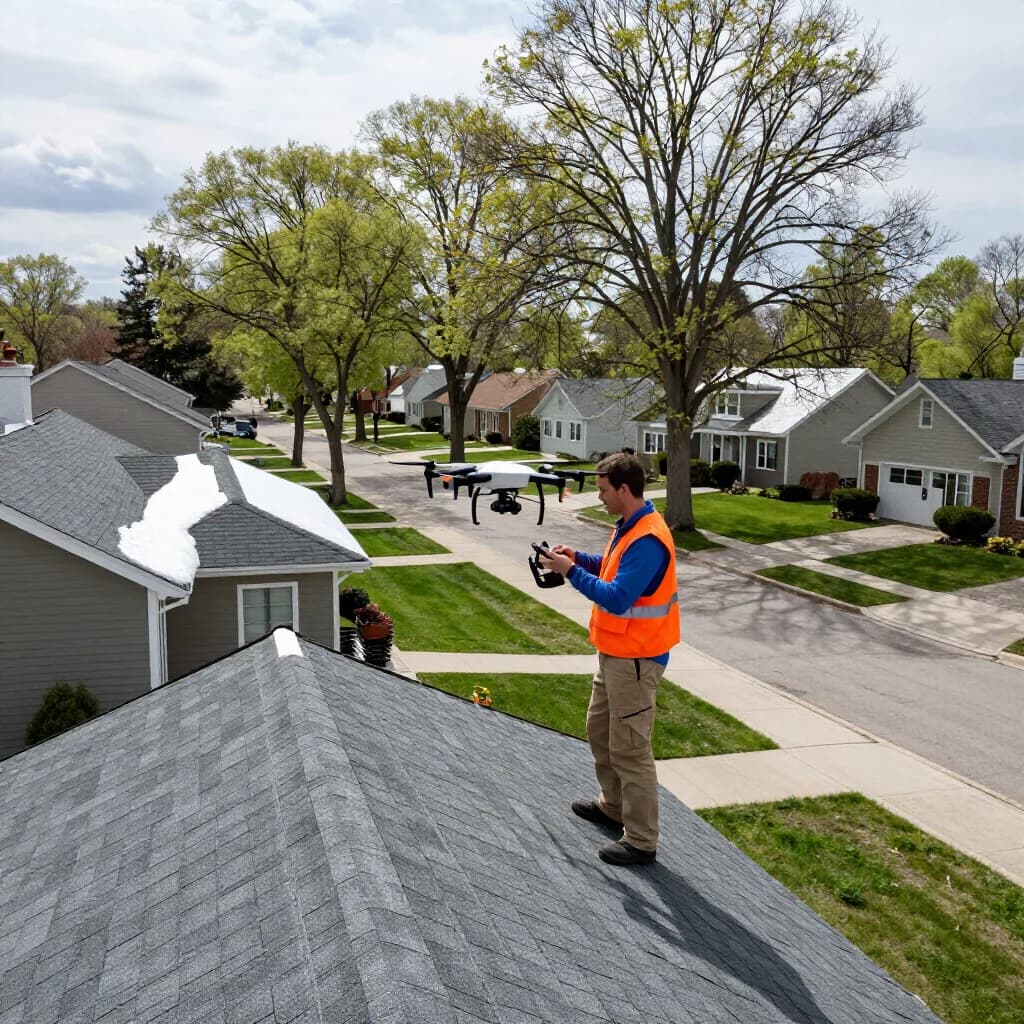
On steep or genuinely unsafe roofs, I'll sometimes pull out a drone to get eyes on areas no one should be walking. But the documentation that wins a claim is still close-up, on-roof photos of the actual hits.
A rough rule of thumb: hail around an inch or larger is usually enough to do damage worth claiming. Smaller than that, sometimes, sometimes not. The only way to know is to look.
What to do in the first week after a Twin Cities hailstorm
- Handle safety and active leaks first. If water's coming in, get a tarp up or call someone who can. Photos and claims come second to keeping water out of your house.
- Write down the storm date and take ground-level photos. Date of loss matters for your claim. Snap the dented gutters, the dinged AC unit, any debris.
- Get a real local inspection — on the roof, with photos. Free, no pressure. A written assessment you keep, whether or not you ever file.
- Decide honestly whether it's worth a claim. If there's no real damage, a good contractor tells you that and shakes your hand. If there is, you move forward knowing it's legitimate.
- File the claim yourself, with your own insurer. This is your call and your paperwork — I'll say more on that below.
- Have your contractor meet the adjuster on the roof. This is where claims get won or lost. You want someone up there pointing out the damage the adjuster might otherwise miss.
How roof insurance claims actually work in Minnesota
A few things are worth understanding before you file, because they change what you walk away with.
ACV vs. RCV. Most policies pay replacement cost value (RCV) but release it in two parts. First you get the actual cash value (ACV) — the depreciated value of your old roof — minus your deductible. Then, after the work is done and invoiced, you recover the held-back depreciation (the "recoverable depreciation"). The number on that first check is not the whole job. That surprises a lot of homeowners.
Your deductible is yours to pay. Nobody can legally absorb it, rebate it, or make it disappear. In Minnesota, a contractor who offers to "waive your deductible" is describing insurance fraud and asking you to take part. Real number, real out-of-pocket — budget for it.
Matching matters here. If the hail-damaged shingles can't be reasonably matched to the undamaged ones, that's a real part of the conversation with your adjuster about what gets replaced. Don't assume a single patch is the only option.
You've usually got about a year. Minnesota claim windows commonly run roughly a year from the date of loss, but the exact deadline is in your policy — check it. The point is you don't have to sign with the first truck in your driveway tonight. You have time to get it right.
Here's the part I want to be straight about: we don't file your claim for you, and we don't do your insurance paperwork. You file with your carrier and you stay in control of your own claim. What we do is get on the roof, document the damage the way an adjuster needs to see it, and meet that adjuster up there with you so the scope is complete. You handle the insurance side; we handle the roof.
What most homeowners get wrong
- Waiting too long. Adjusters book up fast after a big storm, and the longer you wait, the harder it is to tie damage to a specific date of loss.
- Signing an "inspection agreement" on the doorstep. A lot of those forms quietly assign your claim to the contractor. Don't sign anything that hands over control of your claim to get a "free inspection."
- Taking the first estimate as gospel. First passes miss things — damaged flashing, code-required upgrades, vents, the works. Missed line items come out of your pocket later.
- Letting a storm chaser run the whole thing. More on them next.
- Assuming a denial is final. Adjusters are human and roofs are big. A re-inspection with your contractor present sometimes turns a "no" into a "yes."
The storm chasers — and how to spot one
After every real hailstorm, Twin Cities driveways fill up with out-of-state trucks and yard signs you've never seen before. Some are legitimate. A lot are gone before your shingles' first winter. Three tells:
- They knocked within 48 hours of the storm and want you to sign today.
- They offer to cover or "eat" your deductible. Illegal in Minnesota. Walk away.
- Their address is a PO box or an out-of-state suite. Look up the contractor in the Minnesota Department of Labor & Industry license database at dli.mn.gov before anyone gets on your roof — it takes two minutes.
The roofer who'll still answer the phone in year six is almost never the one who showed up uninvited the morning after the storm.
FAQ
Does hail always damage a roof?
No. Plenty of storms drop hail that dings gutters and leaves the shingles fine. Whether your roof is actually damaged depends on stone size, wind, the angle of impact, and the age and type of your shingles. The only reliable way to know is an on-roof inspection — driveway guesses, in either direction, cost people money.
How long do I have to file a hail damage claim in Minnesota?
Most Minnesota policies give you somewhere around a year from the date of the storm, but the exact deadline lives in your policy — read it or ask your insurer. Either way, don't let a door-knocker convince you that you have to decide tonight. You have time to get a real inspection and an honest second opinion first. Here's a real one: a Roseville flat roof where two contractors pushed a needless full replacement after the storm — the roof only needed a couple of small repairs.
Will filing a claim raise my insurance rates?
Hail and wind are usually classified as "acts of God," and a single weather claim typically isn't treated the same way as an at-fault claim. Rate changes vary by carrier and your claim history, so ask your insurer directly. Don't let fear of a rate bump talk you out of a legitimate claim on real damage — that's how a small problem becomes a big one.
What's the difference between ACV and RCV on a roof claim?
Actual cash value (ACV) is the depreciated value of your existing roof — what your first insurance check is usually based on, minus your deductible. Replacement cost value (RCV) is what it actually costs to replace the roof. On an RCV policy, you recover the held-back depreciation after the work is completed and invoiced. So the first check isn't the whole job.
Can a roofer waive or cover my insurance deductible in Minnesota?
No. Minnesota law prohibits a contractor from paying, rebating, or absorbing your insurance deductible, and anyone offering it is committing insurance fraud and inviting you to join them. Your deductible is a real out-of-pocket cost — plan for it, and treat the "we'll cover your deductible" pitch as a red flag to walk away.
How much does a hail-damaged roof replacement cost in the Twin Cities?
A standard architectural asphalt replacement on a typical Twin Cities home runs roughly $14,000–$28,000, and premium materials run higher. On an approved claim, your out-of-pocket is generally your deductible plus any upgrades you choose beyond what's covered — not the full sticker price. We'll give you a line-by-line written quote so you can see exactly what insurance covers and what, if anything, is on you.
Ready for a straight answer on whether the storm actually hit your roof? Call Modern Exterior Systems at 952-206-6339 for a free inspection and a written assessment you keep — no pressure, no clipboard, no chasing you down. If you've got a claim worth filing, we'll meet your adjuster on the roof and make sure nothing gets missed.
Modern Exterior Systems is a women-owned, family-operated roofing and exterior contractor based in Eden Prairie, MN, serving Minneapolis, St. Paul, and the Twin Cities metro. Owner Joe Dvorak brings 20+ years of hands-on construction experience, CertainTeed ShingleMaster, Malarkey Emerald Pro, and Atlas Pro+ certifications, and a LIFETIME workmanship warranty to every residential project. an A+ rating with the BBB.