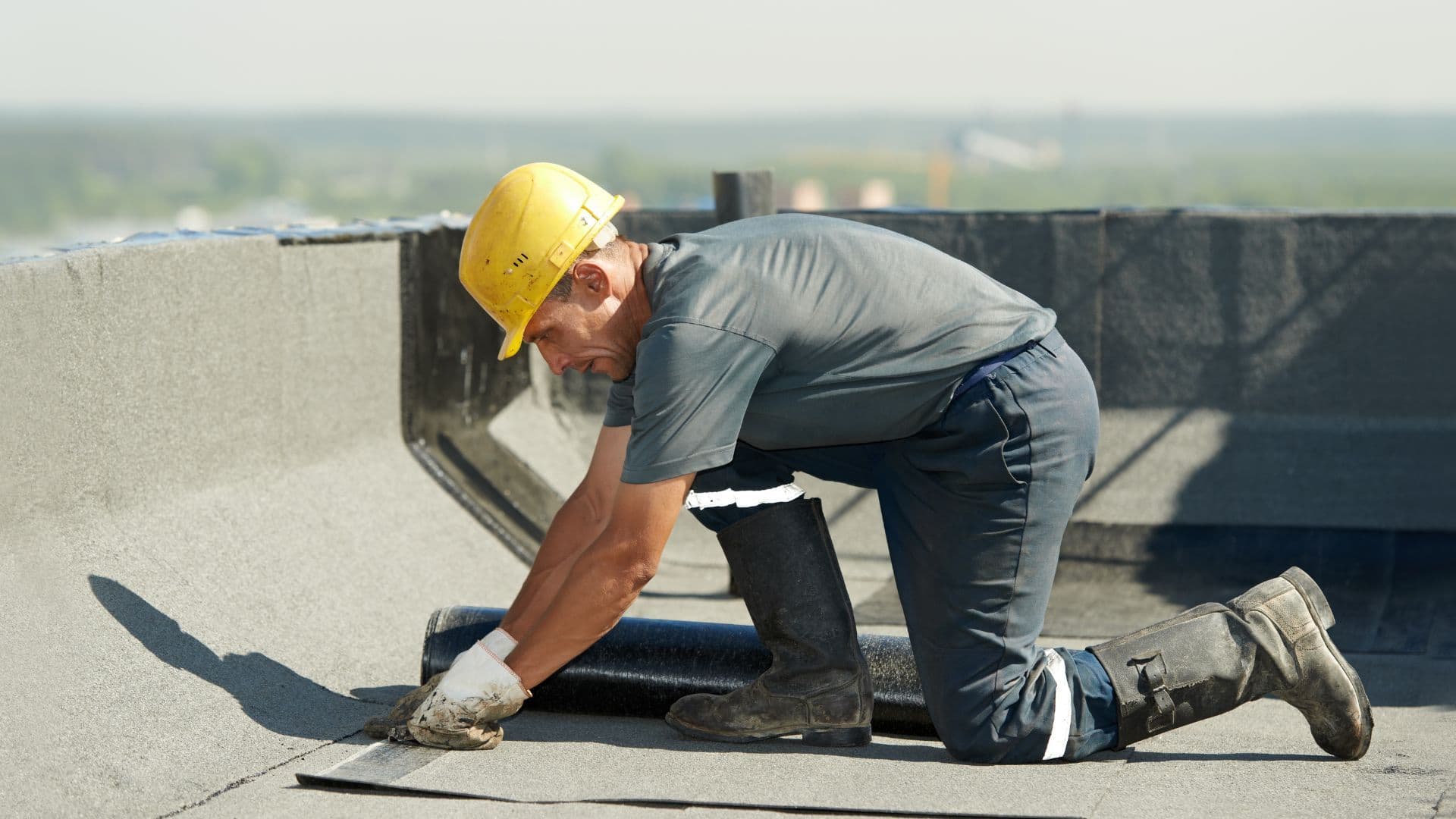
After years of flat-roof work around the Twin Cities — TPO, EPDM, mod-bit, on buildings up to four stories and on houses — I can usually tell within a few minutes on the roof whether you're looking at a repair or a replacement. The trouble is most owners never go up on the roof, so the first sign they get is a stain on the ceiling, which means the problem's been brewing for a while. Here's what to watch for, and what each sign actually means.
The short answer
Catch a flat roof early — a bad seam, a failed flashing, a puncture — and it's almost always a repair. The signs that point toward replacement are widespread membrane failure, trapped wet insulation, and leaks you're chasing faster than you can patch. Ponding water, cracked or shrinking membrane, blisters, and interior stains are your early-warning system. Get up there (safely) or have someone look twice a year.
1. Ponding water that won't drain
Flat roofs aren't truly flat — they're built with a slight slope to drains. When water sits in puddles for more than 48 hours after rain, drainage has failed somewhere, and standing water is a flat roof's worst enemy. It accelerates membrane breakdown, finds seams, and adds weight. Persistent ponding is the single most common thing I see on a tired flat roof.
2. Failing or open seams
Seams are where flat roofs leak first. On TPO they're heat-welded; on EPDM they're taped or glued; on mod-bit the layers are fused. When a seam lifts, opens, or you can slide a tool under it, water's already getting in. A few bad seams on an otherwise healthy roof is a repair. Seams failing across the whole field is end-of-life.
3. Blisters, bubbles, and ridges
Blisters are pockets of air or moisture trapped under or within the membrane. A few small ones aren't an emergency, but big blisters, or a roof covered in them, mean the membrane is delaminating or moisture got in. Once a blister pops, you've got an open leak.
4. Cracks or a membrane that's shrinking
EPDM can shrink and pull as it ages, stressing seams and flashings; TPO and mod-bit can crack or craze when they're at the end of their UV life. If the membrane looks brittle, stretched tight at the edges, or cracked across the field, it's telling you its time is about up.
5. Flashing pulling away from walls and curbs
Flashing seals the membrane to parapet walls, curbs, drains, and rooftop equipment. It's the second-most-common leak point after seams. When flashing lifts, cracks, or separates from a wall, water runs straight behind it. Re-flashing a few spots is a repair; flashing failing everywhere points to a roof that's done.
6. Soft spots underfoot or visible wet insulation
If the roof feels soft, spongy, or uneven when you walk it, there's likely wet insulation trapped under the membrane. Once water's in the insulation, patching the top doesn't fix it — the moisture stays, spreads, and rots the deck. Widespread wet insulation is one of the clearest replacement signals there is.
7. Interior leaks and ceiling stains
The one most people notice first — and the latest one to show up. By the time water reaches a ceiling, it's traveled. A single new stain might trace to one fixable flashing; recurring stains in multiple spots usually mean the membrane is failing in more than one place. Don't just paint over it. Find the source on the roof.
Repair or replace? How I decide
I take it field-by-field. Isolated problems on a membrane with life left = repair, plus a maintenance plan to get more years out of it. The replacement triggers are widespread seam or flashing failure, a membrane that's brittle or shrinking across the roof, and trapped wet insulation. On commercial roofs I'll often pull a small core sample to see what's happening under the membrane before I make the call — because what you can't see is what decides it. If it lands on replacement, here's what a new flat roof costs and how the systems compare. And here's a real one: a Roseville flat roof two other contractors said to replace — that only needed repairs.
FAQ
How do I know if my flat roof needs to be replaced or just repaired?
Isolated issues — a bad seam, a failed flashing, a puncture — on a membrane with life left are usually repairs. Replacement is the call when seams or flashings are failing across the whole roof, the membrane is brittle or shrinking, or there's wet insulation trapped underneath. An on-roof inspection (and a core sample on commercial roofs) tells you which.
Is standing water on a flat roof a problem?
Yes. Flat roofs are built with a slight slope to drains, so water that sits for more than 48 hours means drainage has failed. Standing water accelerates membrane breakdown, works into seams, and adds weight. Persistent ponding is one of the most common signs of a tired flat roof.
How often should I inspect a flat roof?
At least twice a year — spring and fall — plus after any major hail or wind storm. Most flat-roof failures start small and stay invisible from inside the building until they reach a ceiling. Catching a seam or flashing early is the difference between a cheap repair and a replacement.
Why does my flat roof keep leaking after repairs?
Usually because the patches are chasing symptoms, not the source. If the membrane is failing in multiple places, or there's wet insulation under it, surface patches won't hold — the water just finds the next weak spot. Recurring leaks after repairs are often a sign the roof is at end of life.
Can a flat roof be repaired in winter?
Emergency repairs, yes — we can stop active leaks year-round. But full replacements and some membrane repairs need appropriate temperatures to bond properly, so larger work is often best scheduled for milder weather. We'll get you watertight now and plan the bigger job right.
What's the most common cause of flat roof leaks?
Seams and flashings — in that order. The open field of the membrane rarely fails first; it's the welded or taped seams and the flashing around walls, curbs, drains, and rooftop equipment that let water in. That's exactly why installation detail work matters more than the membrane brand.
Worried about your flat roof? Call Modern Exterior Systems at 952-206-6339 for a free on-roof inspection — we'll tell you honestly whether it's a repair or a replacement. Flat roof repair and replacement across the Twin Cities.
Modern Exterior Systems is a women-owned, family-operated roofing and exterior contractor based in Eden Prairie, MN, serving Minneapolis, St. Paul, and the Twin Cities metro. Owner Joe Dvorak brings 20+ years of hands-on construction experience, and backs every project with a workmanship warranty. an A+ rating with the BBB.